
USCIS Green Card Removal Proceedings: What Really Happens When Your Status Is at Risk

I’ve sat across from hundreds of clients who received that letter from immigration court, the one that says they’re in removal proceedings. The fear in their eyes is always the same. They thought their green card meant permanent status. Now they’re facing deportation.
What Are USCIS Green Card Removal Proceedings?
Removal proceedings are the legal process the government uses to deport someone from the United States. Even if you hold a green card, specific actions can land you in immigration court facing a judge who will decide whether you can stay.
The Department of Homeland Security files a Notice to Appear (NTA) charging you with being removable. From that point forward, you’re in proceedings. Your green card doesn’t disappear immediately, but it’s now at serious risk.
Difference Between USCIS and Immigration Court
Here’s something that confuses many people: USCIS handles applications and benefits. Immigration court handles enforcement and removal. Once you’re in removal proceedings, USCIS typically can’t approve most applications you file. The immigration judge now controls your case.
I had a client who tried to renew his green card with USCIS while his case was in proceedings. The application sat there for two years doing nothing because USCIS lacks jurisdiction once you’re in court.
Common Reasons Green Card Holders End Up in Removal Proceedings
Criminal Convictions
This is the number one reason I see green card holders in court. Not all crimes trigger removal, but many do:
Aggravated felonies include:
- Murder
- Rape
- Sexual abuse of a minor
- Drug trafficking
- Firearms trafficking
- Money laundering over $10,000
- Fraud or tax evasion over $10,000
- Theft or burglary with a sentence of at least one year
Crimes involving moral turpitude cover:
- Fraud
- Theft
- Assault with intent to harm
- Domestic violence
- Many drug offenses
I represented a man who got a DUI. Just one. He’d had his green card for eight years, owned a home, and had three US citizen kids. The DUI became a removal ground because he also had an old shoplifting conviction from years before. Two crimes involving moral turpitude committed within five years of admission are grounds for deportability.
He had no idea that the old shoplifting case would come back to haunt him.
Immigration Fraud
If USCIS discovers you lied on your green card application, they can place you in removal proceedings even years later. This includes:
- Fake marriages
- Using someone else’s identity
- Hiding criminal history
- Lying about employment
- Concealing prior deportations
Real case: A woman married a US citizen. They lived together for three years and had a child. After getting her green card, she left him and married someone else within months. USCIS investigated, found text messages proving the first marriage was fraudulent, and initiated USCIS green card removal proceedings. The child and the years of marriage didn’t matter; the fraud at the start invalidated everything.
Abandonment of Residence
Green card holders must maintain US residence. If you stay outside the country too long without a reentry permit, CBP can refer you to immigration court upon return.
The standard is usually six months to a year, but I’ve seen cases triggered by shorter absences when combined with other factors:
- Selling your US home
- Taking a job abroad
- Filing taxes as a nonresident
- Keeping minimal US ties
Public Charge
Using certain public benefits can, in rare circumstances, trigger removal, particularly if obtained through fraud. This is less common than people fear, but it happens.
Conditional Residence Issues
If you got your green card through marriage and it’s conditional (valid for 2 years), failing to file Form I-751 properly can result in removal proceedings. I’ve seen this happen when couples divorce within two years, and the immigrant doesn’t realize they need to file alone with a waiver.
Removal Proceedings Timeline
Let me break down what actually happens step by step.
Step 1: The Notice to Appear
You receive a document charging you with specific grounds of removability. It lists:
- Your biographical information
- The charges against you
- The laws you allegedly violated
- Your initial hearing date and location
Critical mistake people make: Ignoring it. I had a client who thought it was junk mail because it looked like a form. He missed his hearing. The judge ordered him deported in absentia. We spent two years trying to reopen that case.
Step 2: Master Calendar Hearing
This is your first court appearance. It’s usually quick, 15 minutes or less. The judge:
- Confirms your identity
- Ensures you received proper notice
- Asks if you want a lawyer (if you don’t have one)
- Have you admitted or denied the charges
- Schedules your next hearing
You don’t present evidence yet. This is administrative.
Tip from experience: Never admit the charges without talking to a lawyer first, even if they seem accurate. You might have defenses you don’t know about.
Step 3: Individual Hearing
This is your trial. It can last hours or multiple days, depending on complexity. The government presents evidence proving you’re removable. You present defenses and applications for relief.
Here’s the structure:
- Government’s case: ICE attorney presents evidence (criminal records, immigration documents, witness testimony)
- Your case: You present defenses and relief applications
- Legal arguments: Both sides make arguments to the judge
- Decision: Judge rules from the bench or issues a written decision later
Step 4: Appeals
If you lose, you can appeal to the Board of Immigration Appeals (BIA) within 30 days. If you fail there, you can petition the federal Court of Appeals.
Appeals take years. I have cases at the BIA that have been pending for three years.
Forms of Relief Available in Removal Proceedings
Just because you’re in USCIS green card removal proceedings doesn’t mean you’ll be deported. Several forms of relief exist.
Cancellation of Removal for Permanent Residents
This is the most common relief I file for green card holders. To qualify, you must prove:
- You’ve been a permanent resident for at least 5 years
- You’ve resided continuously in the US for at least 7 years after being admitted in any status
- You haven’t been convicted of an aggravated felony
If you win, the judge cancels the removal, and you keep your green card.
The 7-year requirement trips people up: Certain convictions “stop the clock” on your continuous residence. If you committed a crime involving moral turpitude or most other removal grounds before you had 7 years of residence, you can’t use cancellation.
I had a client who had been a green card holder for 15 years. But he got a drug conviction in year 6. That stopped his clock at 6 years. He couldn’t apply for cancellation even though he’d lived here for 15 years total.
Adjustment of Status
If you’re eligible for a new green card (usually through a family petition), you can apply for adjustment during removal proceedings. The judge decides whether you qualify, rather than USCIS.
Typical scenario: A green card holder with a criminal conviction marries a US citizen. The citizen files an I-130 petition. In removal proceedings, the immigrant applies to adjust status based on that petition.
This doesn’t work for everyone. Certain criminal convictions create barriers to adjustment.
Waivers
Several waivers might apply depending on your situation:
- I-601 Waiver: Forgives specific grounds of inadmissibility if removal would cause extreme hardship to a US citizen or permanent resident spouse or parent
- 212(h) Waiver: Forgives certain criminal grounds if you meet specific requirements
- I-212 Waiver: Allows reentry if you were previously deported
Each waiver has strict requirements. The “extreme hardship” standard is particularly tough. Financial hardship alone doesn’t qualify. You need to show exceptional circumstances beyond what any family would face from separation.
Asylum or Withholding of Removal
If you fear persecution in your home country based on race, religion, nationality, political opinion, or membership in a particular social group, you can apply for asylum even with a green card.
This is rare for green card holders, but it does come up in some cases. I represented a green card holder from Venezuela who faced removal due to a criminal conviction. He applied for asylum based on changed conditions in Venezuela. He won.
Voluntary Departure
If you don’t qualify for relief, voluntary departure lets you leave on your own within a set time period (usually 60-120 days). Benefits include:
- No deportation order on your record
- Easier to return legally in the future
- You might qualify for relief you don’t qualify for if deported
But if you don’t leave on time, the voluntary departure automatically converts to a deportation order, and you face a $5,000 civil penalty.
What Happens During the Individual Hearing
Let me describe what actually happens in the courtroom based on hundreds of hearings I’ve attended.
Before the Hearing Starts
You check in with the court security officer. You sit in the gallery until your name is called. Immigration courts are open to the public, so there might be 20-30 other people waiting for their cases.
When your name is called, you approach the respondent’s table. The ICE attorney sits at the government’s table. The judge sits elevated at the bench.
Opening Statements
Brief. The judge usually knows the issues from your filings. The ICE attorney might outline their position. You or your lawyer do the same.
Evidence Presentation
ICE goes first if they have additional evidence beyond what’s in your file. Usually, they don’t need to present much; your criminal records and immigration documents speak for themselves.
Then you present your case:
- Testimony: You testify about your life, ties to the US, rehabilitation (if criminal case), fear of persecution (if asylum), hardship to family, etc.
- Witness testimony: Family members, employers, and community members testify about your character and their relationship with you
- Documentary evidence: Letters of support, medical records, psychological evaluations, country condition reports, proof of rehabilitation, employment records, tax returns, etc.
Cross-Examination
The ICE attorney can cross-examine you and your witnesses. They’re usually respectful but can be tough on inconsistencies.
Example: I had a client testifying about his reformed character after a drug conviction. On cross-examination, ICE asked if he’d been fired from his job. He said no. ICE produced termination paperwork showing he was fired for failing a drug test three months earlier. The judge’s trust evaporated. We lost.
Always tell the truth, even when it hurts your case.
Closing Arguments
Both sides summarize the evidence and argue how the law applies. This is where legal advocacy matters most.
Decision
Some judges rule immediately from the bench. Others take the case “under advisement” and mail a written decision weeks or months later.
If you win, you get documentation confirming your status. If you lose, you typically have 30 days to appeal.
Common Mistakes That Destroy Cases
I’ve seen good cases ruined by avoidable mistakes. Here are the most common:
Missing Court Dates
An in absentia deportation order is a disaster. The judge isn’t required to tell you why you’re removable or consider any relief. You’re just been ordered deported.
Reopening these cases requires proving you didn’t receive notice or had “exceptional circumstances” preventing your attendance. It’s an uphill battle.
Lying or Minimizing
Judges can smell dishonesty. I’ve seen respondents minimize a “bar fight” that was actually a brutal assault with a weapon. When the police report comes out during the hearing, credibility is destroyed.
If you did something wrong, own it and show what you’ve done to change.
Waiting Too Long to Get a Lawyer
Some people try to handle master calendar hearings on their own, thinking they’ll get a lawyer later, but it’s a bad idea. Important deadlines and strategic decisions happen early. Once you waive certain rights or miss specific deadlines, they’re often gone forever.
Not Gathering Evidence Early
Building a strong case takes time. You need:
- Character letters from people who know you well (not generic templates)
- Evidence of rehabilitation (completion of programs, therapy, community service)
- Hardship evidence (medical records, psychological evaluations, financial documents)
- Country condition reports (for asylum cases)
I can’t count how many clients have come to me two weeks before their individual hearing with nothing prepared. We scramble, but the case suffers.
Committing New Crimes
I’ve had clients in removal proceedings who get arrested again. It’s devastating. Even if the new charge is minor, it shows the judge you haven’t learned.
Leaving the Country
Once you’re in removal proceedings, leaving the US without the judge’s permission can destroy your case. The judge might find you abandoned your applications. Even worse, if you had pending applications for relief, leaving might make you ineligible when you return.
How Criminal Convictions Complicate USCIS Green Card Removal Proceedings
Criminal issues dominate the immigration court. Let me explain the key concepts.
“Conviction” Definition
Immigration law has its own definition of conviction. It includes:
- A formal judgment of guilt by a court
- A plea of guilty or no contest
- Sufficient evidence to find you guilty, even if adjudication was withheld
Critical point: Even if your criminal record was expunged, sealed, or dismissed, it might still count as a conviction for immigration purposes.
I had a client whose Texas deferred adjudication (not a conviction under state law) was counted as a conviction for immigration purposes. He faced removal even after completing probation, and the case was dismissed.
Aggravated Felonies
This is the worst category. Aggravated felony convictions:
- Bar almost all relief from removal
- Trigger mandatory detention (no bond)
- Result in permanent inadmissibility
- Lead to expedited removal proceedings
The term “aggravated felony” is misleading. It includes misdemeanors under state law. What matters is:
- The type of crime
- The potential sentence (even if you didn’t serve it)
- The actual sentence imposed
Example: Theft with a potential sentence of one year is an aggravated felony, even if you only got probation.
Crimes Involving Moral Turpitude
These crimes involve:
- Fraud or deceit
- Intent to harm persons or things
- Serious violations of morality
Courts analyze the statutory elements of your conviction, not what actually happened. If the statute under which you were convicted could be violated by conduct involving moral turpitude, it counts even if your specific conduct was less severe.
This gets complicated fast. Different circuits interpret things differently.
Post-Conviction Relief
Sometimes we can reopen or vacate criminal convictions to eliminate their immigration consequences. This requires:
- A viable legal basis (ineffective assistance of counsel is everyday)
- A criminal attorney who understands immigration law
- Cooperation from the prosecutor
- A willing criminal court judge
I’ve successfully vacated convictions that saved clients from deportation. But it’s not guaranteed and takes significant time and money.
Detention During Removal Proceedings
Not everyone in removal proceedings gets detained, but many do.
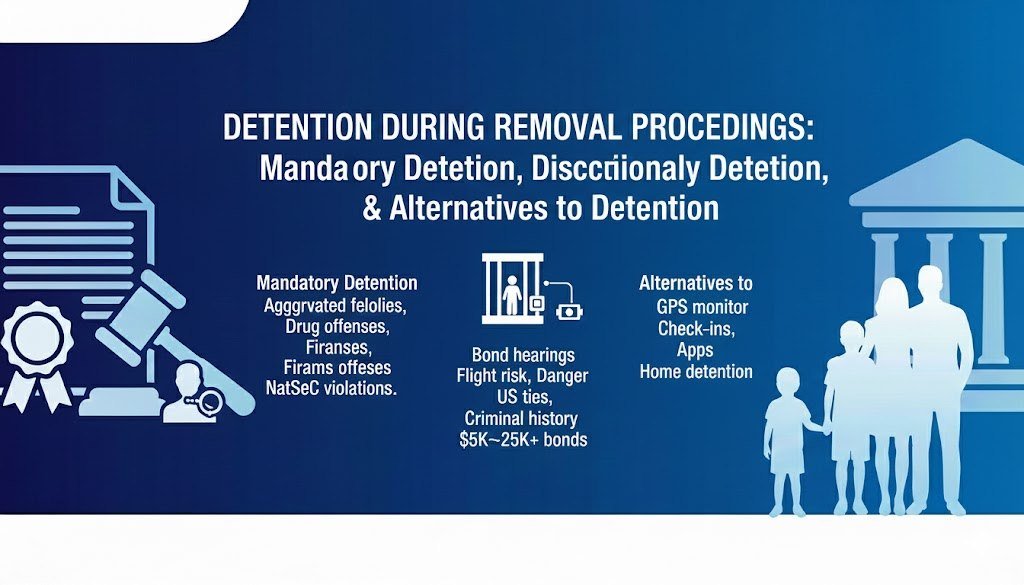
Mandatory Detention
If you have certain criminal convictions, ICE must detain you without a bond hearing. No discretion. You stay locked up until your case ends.
Mandatory detention applies to:
- Aggravated felonies
- Controlled substance offenses (with limited exceptions)
- Firearms offenses
- Certain national security violations
Discretionary Detention
For other cases, ICE decides whether to detain you. If detained, you can request a bond hearing before an immigration judge.
The judge considers:
- Flight risk
- Danger to the community
- Ties to the US
- Criminal history
- Likelihood of success in removal proceedings
Bonds typically range from $5,000 to $25,000, but can go higher.
Alternatives to Detention
In some cases, ICE releases people with conditions:
- GPS ankle monitor
- Regular check-ins
- Reporting apps
- Home detention
How Long Do Removal Proceedings Take?
There’s no standard timeline. I’ve seen cases resolve in six months and others drag on for seven years.
Factors affecting timeline:
- Court backlog (currently over 3 million pending cases)
- Complexity of your case
- Number of hearings needed
- Appeals
- Whether you’re detained (detained cases move faster)
- Your attorney’s preparation
Typical timeline for a non-detained case:
- NTA issued: Day 0
- First master calendar hearing: 6-18 months
- Individual hearing scheduled: 12-36 months after first hearing
- Individual hearing completed: Could take multiple days over several months
- Judge’s decision: Immediately or within a few months
- BIA appeal (if needed): 1-4 years
- Federal court appeal (if needed): 1-3 years
Emotional Reality of Removal Proceedings
The legal analysis is essential, but let me talk about what this actually feels like for people.
Stress on Families
I’ve watched US citizen children testify about what losing their parents would mean. I’ve seen spouses break down describing their partner’s rehabilitation. I’ve had elderly parents explain they can’t travel to visit their child if deported due to health issues.
The stress of pending removal proceedings fractures families. People can’t plan for the future. They can’t travel. They live in constant fear.
Financial Burden
Removal defense costs thousands of dollars:
- Attorney fees: $5,000-$25,000+ depending on complexity
- Expert witnesses: $2,000-$5,000
- Psychological evaluations: $1,500-$3,000
- Translation services: $500-$2,000
- Appeal costs: Additional thousands
Many families go into debt or liquidate savings.
Employment Challenges
Your work authorization might continue during proceedings, but employers sometimes terminate people in removal proceedings. Finding new employment becomes harder when you can’t promise you’ll remain in the country.
Psychological Toll
Depression and anxiety are common. Some people develop PTSD-like symptoms. The uncertainty, especially in cases that drag on for years, is mentally exhausting.
I always connect clients with mental health resources. Judges are more sympathetic when they see you’re taking your mental health seriously.
Working With an Immigration Attorney
Let me be direct: you need a lawyer for removal proceedings. The law is too complex and the stakes too high.
What to Look For
Experience in immigration court: USCIS and court work are different animals. Find someone who regularly appears in immigration court.
Specialization in removal defense: Immigration law is vast. Some attorneys focus on family petitions or business visas. You want someone focused on removal defense.
Communication style: You’ll work with this person for months or years. Make sure they explain things clearly and respond to your questions.
Realistic assessment: Be wary of attorneys who guarantee results. Good lawyers explain the law, assess your chances honestly, and develop a strategy, but don’t promise wins.
What Your Attorney Should Do
A good removal defense attorney will:
- Analyze all possible grounds of removal
- Identify all available relief
- Develop a case theory
- Gather and organize evidence
- Prepare you for testimony
- Coordinate with criminal attorneys if needed
- File necessary motions and briefs
- Represent you at all hearings
- Handle appeals if necessary
Red Flags
Avoid attorneys who:
- Guarantee you’ll win
- Promise to “fix” things through connections
- Ask you to lie
- Don’t give you copies of documents
- Miss deadlines
- Don’t show up prepared for court
- Suggest fraudulent marriages or other illegal schemes
Life After Removal Proceedings
If You Win
Winning feels incredible. You get documentation confirming your status. Your green card remains valid. You can eventually apply for citizenship (timing depends on your specific case).
But stay clean: Another criminal conviction could land you back in court. Many relief forms are one-time only.
If You Lose
A removal order means you must leave. If you don’t leave voluntarily, ICE will deport you.
Consequences of deportation:
- Bars to returning (5, 10, or 20 years, or permanent, depending on circumstances)
- Difficulty traveling anywhere (many countries check for US removal orders)
- Separation from family
- Starting over in a country you might barely remember
Options after deportation:
- Apply for permission to reapply for admission (I-212 waiver)
- Wait for bars to expire
- Seek relief from abroad if eligible
- In rare cases, reopen removal proceedings if new evidence emerges
Practical Steps If You’re Facing Removal
If you’ve received an NTA or fear you might be placed in USCIS green card removal proceedings:
Immediately:
- Find an experienced immigration attorney
- Gather all immigration documents
- Collect criminal records and disposition paperwork
- Do not leave the country without consulting your attorney
- Do not miss any court dates
Short term (first few months):
- Document all US ties (employment, property, family, community involvement)
- Begin gathering character letters
- Complete any rehabilitation programs related to criminal issues
- Seek psychological evaluation if relevant
- Research the country conditions if considering asylum
Long term (throughout proceedings):
- Maintain stable employment
- Stay out of legal trouble
- Attend all court dates
- Follow all the attorney’s advice
- Keep copies of everything filed with the court
Final Thoughts
I’ve been doing this work for years. I’ve seen people deported who deserved to stay. I’ve seen people win who I thought would lose. Immigration judges have enormous discretion.
What makes the difference? Preparation, honesty, and showing the judge you deserve a second chance.
If you’re in removal proceedings, don’t give up. The system is designed to be confusing and intimidating. But relief exists for many people. Fight for your case, get good representation, and present yourself honestly.
Your green card might feel like it’s hanging by a thread. With the right approach, you can cut that thread and tie a stronger knot. But you have to act quickly and strategically.
The government has attorneys, investigators, and resources. You need an equally strong team on your side. Don’t face USCIS green card removal proceedings alone.