
Birthright Citizenship in the United States: What You Actually Need to Know

I’ve spent years helping families navigate citizenship questions, and birthright citizenship remains one of the most misunderstood areas of immigration law. Parents call my office panicked about what their child’s birth certificate actually means. Families worry about documentation. And honestly, there’s a lot of bad information floating around.
Let me go through what birthright citizenship actually means, how it works in real cases, and what I tell clients who come to me with these questions.
What Birthright Citizenship Actually Means
Birthright citizenship in the United States means that if you’re born on U.S. soil, you’re automatically a U.S. citizen. Period. It doesn’t matter if your parents are citizens, green card holders, temporary workers, students, or even in the country without authorization.
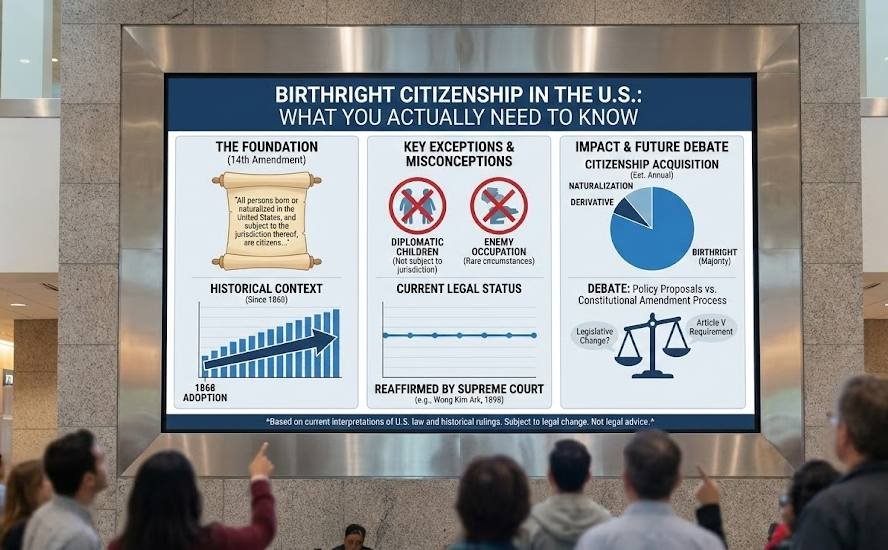
The Fourteenth Amendment to the Constitution establishes this right. It states: “All persons born or naturalized in the United States, and subject to the jurisdiction thereof, are citizens of the United States.”
This has been the law since 1868. It’s not a policy that changes from administration to administration. It’s constitutional law.
Constitutional Foundation
The Fourteenth Amendment was adopted after the Civil War, specifically to ensure that formerly enslaved people and their children were recognized as citizens. But its language is broad, and courts have consistently interpreted it to apply to almost everyone born on U.S. territory.
The key phrase is “subject to the jurisdiction thereof.” Courts have interpreted this very narrowly. It essentially excludes only:
- Children of foreign diplomats
- Children of enemy soldiers during wartime occupation
- Children born to members of Native American tribes (though this changed with the Indian Citizenship Act of 1924)
That’s it. If you’re born in the United States and your parents don’t fall into one of these extremely narrow categories, you’re a U.S. citizen from birth.
How Birthright Citizenship Works in Real Cases
Let me share some actual scenarios I’ve dealt with. Names changed, obviously.
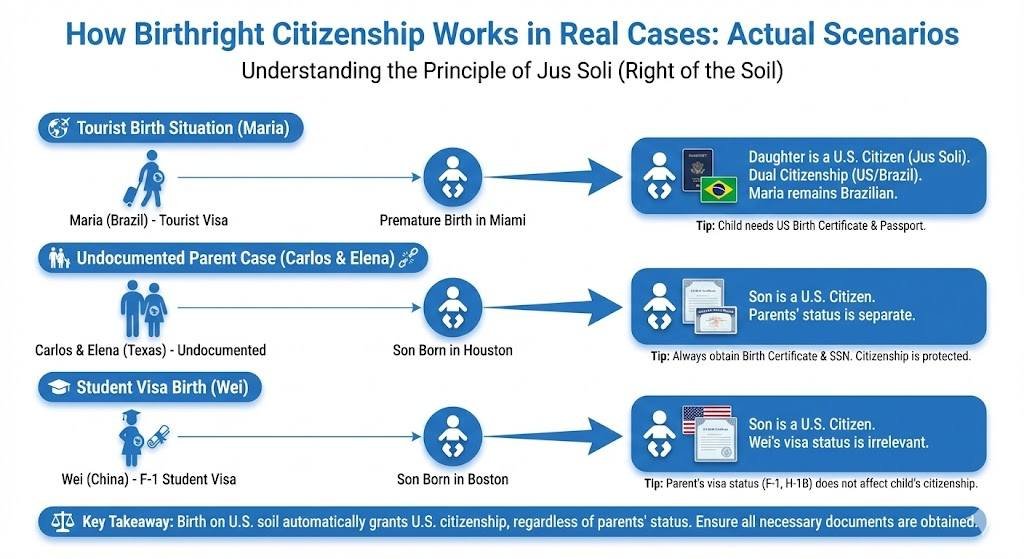
Tourist Birth Situation
Maria came to the U.S. from Brazil on a tourist visa. She was six months pregnant but planned to visit for only two weeks. She went into premature labor and gave birth in Miami.
Her question: “Is my baby really American?”
Yes. Her daughter was born on U.S. soil, so she’s a U.S. citizen. Maria got a U.S. birth certificate and applied for a passport for her daughter. Maria herself remained a Brazilian citizen and had to return to Brazil before her visa expired.
This happens more often than you’d think. The child has dual citizenship—Brazilian through Maria and American by birth.
Undocumented Parent Case
Carlos and Elena had been living in Texas without authorization for eight years. When Elena became pregnant, they worried their son wouldn’t be able to get citizenship.
Wrong. Their son, born in Houston, is a U.S. citizen. His parents’ immigration status is entirely separate from his citizenship status.
This is where families make critical mistakes. They sometimes avoid getting birth certificates or Social Security numbers because they’re afraid of immigration consequences. Don’t do this. Your child’s citizenship is protected, and they need these documents.
Student Visa Birth
Wei came to the U.S. on an F-1 student visa to attend graduate school. She got married, became pregnant during her second year, and gave birth in Boston.
Her son is a U.S. citizen. Wei’s visa status doesn’t change this fact. She remained on her student visa and later adjusted to an H-1B work visa, but her son was American from the moment he was born.
Common Misconceptions I Have to Correct
“Birth Tourism” and Its Legal Reality
People talk about “birth tourism” like it’s illegal. It’s not. Coming to the U.S. on a tourist visa and giving birth here doesn’t violate any law, as long as you’re honest about your intentions and pay your medical bills.
The issue arises when people lie to immigration officers. If you say you’re coming for a vacation, but you’re actually coming specifically to give birth, that’s visa fraud. If you receive medical care and leave without paying, that’s a civil debt issue.
But the child’s citizenship is never in question. Even if the parents did something wrong, birthright citizenship in the United States doesn’t depend on the parents’ behavior or intentions.
“Anchor Baby” Myths
This term is offensive and also legally meaningless. Here’s what actually happens:
A child born in the U.S. is a citizen. But that child cannot petition for their parents to get green cards until they turn 21. That’s more than two decades away.
Even then, if the parents were ever in the U.S. without authorization, they may face barriers to reentry. Having a U.S. citizen child doesn’t automatically fix immigration violations.
I’ve represented families who believed that having a U.S.-born child would immediately help their cases. It doesn’t work that way. The child’s citizenship and the parents’ immigration status are separate tracks that rarely intersect in helpful ways for at least 21 years.
Dual Citizenship Confusion
Parents often ask: “If my child is born here but we’re from Country X, do they have to choose?”
Most countries allow dual citizenship. Your child can be both a U.S. citizen and a citizen of your home country. The United States absolutely recognizes dual citizenship and doesn’t require anyone to choose.
You should check the laws in your home country. Some countries (such as India and China) have restrictions, but most allow children to retain both citizenships.
Documentation: What You Actually Need
Here’s the practical stuff that matters when a child is born in the United States.
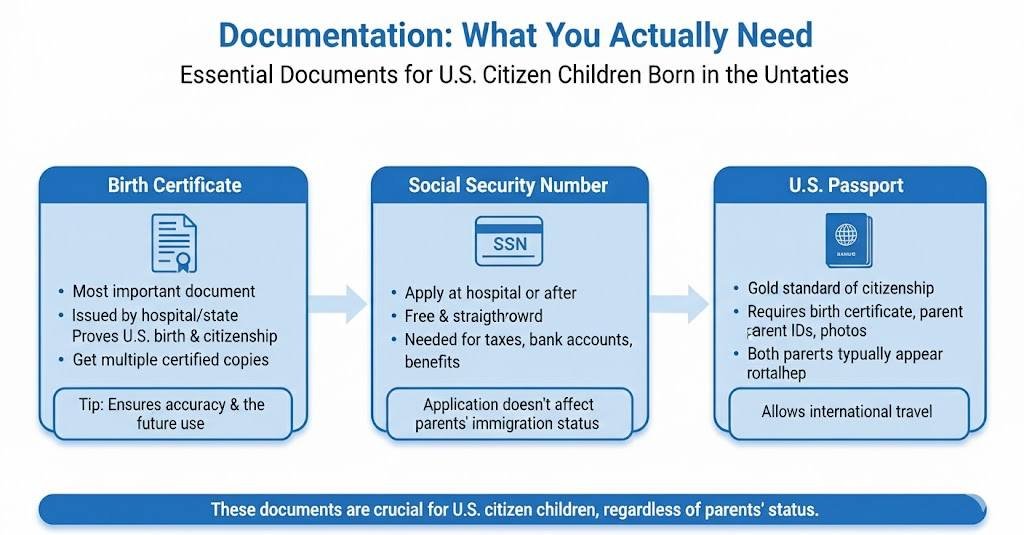
Birth Certificate
This is your most important document. The hospital will help you apply for it, usually before you leave. The birth certificate proves your child was born in the U.S. and is therefore a citizen.
Make sure all information is accurate. Fixing errors later is a nightmare.
Get multiple certified copies. You’ll need them for passports, school enrollment, Social Security, and various other purposes throughout your child’s life.
Social Security Number
Apply for your child’s Social Security number at the hospital or shortly after birth. This is free and straightforward. You’ll need this number for tax purposes and to open bank accounts or apply for government benefits on your child’s behalf.
Some parents worry that applying for a Social Security number will expose their immigration status. This fear is understandable but misplaced. The Social Security Administration doesn’t share information with immigration enforcement to enforce immigration laws against parents who apply for benefits for their U.S. citizen children.
U.S. Passport
A U.S. passport is the gold standard for proving citizenship. For a newborn, you’ll need:
- Certified birth certificate
- Parental identification
- Passport photos
- Application form DS-11
- Fee payment
Both parents typically need to appear in person or provide notarized consent if one parent can’t attend.
The passport proves your child’s citizenship and allows them to travel internationally and return to the U.S.
Special Situations That Come Up
Birth on U.S. Military Bases Abroad
I get asked about this constantly. If your child is born on a U.S. military base overseas, are they a U.S. citizen?
It depends. The military base itself isn’t considered U.S. territory for purposes of birthright citizenship. But the child may still be a U.S. citizen based on the parents’ citizenship status and time spent in the U.S.
This falls under different rules—not birthright citizenship in the United States as we’re discussing here, but citizenship by descent.
U.S. Territories
Children born in Puerto Rico, Guam, the U.S. Virgin Islands, and the Northern Mariana Islands are U.S. citizens at birth.
American Samoa is the exception. People born in American Samoa are U.S. nationals but not citizens at birth. They can naturalize more easily than foreign nationals, but there’s an extra step.
Foreign Diplomat Exception
If your parent was a foreign diplomat with complete diplomatic immunity at the time of your birth, you’re not a U.S. citizen even if born here. This is the one real exception based on the “subject to the jurisdiction” language.
This is rare and requires formal diplomatic status, not just working at an embassy.
Real Legal Challenges and Court Cases
United States v. Wong Kim Ark (1898)
This Supreme Court case established the current interpretation of birthright citizenship in the United States. Wong Kim Ark was born in San Francisco to Chinese immigrant parents who could not become citizens due to racist exclusion laws.
When he traveled to China and tried to return, the U.S. government denied him entry, claiming he wasn’t a citizen.
The Supreme Court ruled that he was indeed a U.S. citizen by birth. The court held that the Fourteenth Amendment meant what it said—anyone born on U.S. soil (except for the narrow exceptions) is a citizen.
This case has stood for over 125 years.
Modern Legal Debates
Some politicians and legal scholars argue that birthright citizenship should be limited, particularly for children of parents in the country without authorization.
These proposals face enormous constitutional hurdles. The Fourteenth Amendment needs to be changed, requiring a two-thirds vote in Congress and ratification by three-fourths of the state legislatures.
Even executive orders attempting to redefine birthright citizenship would face immediate legal challenges and would likely be struck down as unconstitutional.
As of now, the law is clear and unchanged.
What This Means for Different Groups
For Tourists and Temporary Visitors
If you give birth while lawfully in the U.S., your child is a citizen. You must leave the United States before your visa expires unless you adjust your status through another means.
Your child can sponsor you for a green card when they turn 21, but you’ll need to deal with any prior immigration violations at that time.
For People Without Legal Status
Your U.S.-born children are citizens with all the rights that entail. This includes public education, emergency medical care, and the ability to petition for you after age 21.
However, having a U.S. citizen child does not protect you from deportation. I’ve represented families where parents were removed while their U.S. citizen children remained in the U.S. with other family members or returned to the parents’ home country with them.
This is heartbreaking and one of the most complex parts of my practice.
For Green Card Holders
Your children born in the U.S. are citizens, not permanent residents like you. They have more rights, including the right to vote and to hold specific government jobs.
When your children turn 18, their citizenship can help you naturalize faster if you choose to become a citizen yourself.
For U.S. Citizens Living Abroad
If you’re a U.S. citizen and give birth outside the U.S., your child may be a citizen through you, but that’s different from birthright citizenship. Those cases depend on factors like how long you lived in the U.S. before your child’s birth.
Practical Mistakes Families Make
Not Getting Documents Promptly
Get your child’s birth certificate and Social Security number immediately. Delays create problems later.
I’ve seen families wait years to get these documents, which then complicates school enrollment, medical care, and passport applications.
Leaving the U.S. Without a Passport
If your child is a U.S. citizen and you plan to take them abroad, get their passport first. You need it to bring them back into the U.S.
Airlines may not let you board without proper documentation. At best, you’ll face significant delays. At worst, you could be separated from your child at the border.
Not Understanding Long-Term Implications
Parents sometimes think their child’s citizenship immediately helps their immigration situation. Plan for the reality: your child can help you in 21 years, not now.
Make other immigration plans if possible. Don’t rely solely on your child’s future ability to petition on your behalf.
Assuming Citizenship Can Be Taken Away
U.S. citizenship is nearly impossible to lose involuntarily. Your child’s citizenship cannot be revoked because of your actions or immigration status.
The only ways to lose citizenship are:
- Voluntarily renouncing it
- Fraudulently obtaining it in the first place (and this is discovered)
- Treason in minimal circumstances
A child born in the U.S. acquires citizenship by birth, so it’s highly secure.
Financial and Healthcare Considerations
Hospital Bills
Give birth in the U.S., and you’ll receive a hospital bill. These can be substantial—tens of thousands of dollars without insurance.
If you’re here temporarily and leave without paying, the hospital may send your bill to collections. This won’t affect your child’s citizenship, but it could impact your ability to get future U.S. visas.
Many hospitals have payment plans or charity care programs. Ask about these before or immediately after giving birth.
Insurance Coverage
Tourists typically don’t have U.S. health insurance. Travel insurance may cover some costs but often excludes pregnancy-related expenses.
Your U.S. citizen child may qualify for Medicaid or CHIP (Children’s Health Insurance Program), depending on your state and circumstances. These programs provide health coverage for children in low-income families.
Enrolling your child in these programs won’t affect your immigration status, though some parents worry about this.
Public Benefits and “Public Charge”
Your U.S. citizen child can receive public benefits for which they’re eligible without affecting your immigration status. The child is American.
However, if you’re applying for a green card or visa, receiving certain public benefits yourself could be considered under public charge rules. This gets complicated fast, and you should consult an immigration attorney about your specific situation.
State-by-State Variations
Birthright citizenship in the United States is federal law, so it doesn’t vary by state. However, how easy it is to get documentation can vary.
Birth Certificate Processing
Some states issue birth certificates within days. Others take weeks. Processing times and fees differ significantly.
California and Texas, which have large immigrant populations, generally have well-developed systems. Smaller states may have less experience with parents who hold foreign documents or have limited English proficiency.
Hospital Policies
Some hospitals in border areas have specific protocols for foreign patients giving birth. They may require payment up front or have bilingual staff who handle documentation routinely.
Other hospitals may be less familiar with these situations and may not know the correct procedures.
What to Do If Problems Arise
Challenges to Your Child’s Citizenship
This is rare, but if anyone questions your child’s citizenship, you have options:
- The birth certificate is usually sufficient proof
- A U.S. passport is even stronger
- If someone actually denies your child’s citizenship (extremely rare), contact an immigration attorney immediately
I’ve practiced for years and have never seen a legitimate case where a child born in the U.S. to non-diplomatic parents was denied citizenship. The law is too clear.
If You’re Facing Deportation
If you’re in deportation proceedings and have U.S. citizen children, this may be a factor in your case, but it’s not automatic protection.
You can argue for cancellation of removal or prosecutorial discretion based on your children’s needs and your ties to them. Success depends heavily on your specific circumstances.
Work with an experienced immigration attorney on these cases. The stakes are too high to navigate alone.
Looking Forward: Your Child’s Future
Rights and Responsibilities
Your U.S. citizen child has the right to:
- Live permanently in the U.S.
- Attend public schools
- Vote when they turn 18
- Hold a U.S. passport
- Apply for federal jobs
- Run for any office except President (if they meet age requirements)
They also have responsibilities:
- Registering for Selective Service at 18 (for males)
- Filing U.S. taxes on worldwide income
- Obeying U.S. laws
Sponsoring Family Members
At age 21, your child can petition for:
- Parents (you)
- Siblings
- Spouses
- Children
This process takes time and has requirements, but it’s a path many families use.
Dual Citizenship Considerations
If your child has dual citizenship, they can generally maintain both throughout their life. The U.S. won’t force them to choose.
They may need to meet obligations in both countries (like military service requirements in some countries). Research the specific laws in your home country.
Comparison: U.S. vs. Other Countries
| Country | Birthright Citizenship | Conditions |
|---|---|---|
| United States | Yes | Nearly automatic |
| Canada | Yes | Nearly automatic |
| Mexico | Yes | Nearly automatic |
| United Kingdom | No | Requires parent with settled status |
| Germany | No | Requires parent with citizenship or long-term residence |
| Australia | No | Requires parent as citizen/permanent resident |
| France | Limited | Available at age 18 if raised there |
| Japan | No | Based on parent citizenship only |
The United States is among a minority of countries that still grant automatic birthright citizenship based purely on place of birth. Most developed countries have moved to more restrictive systems.
Final Practical Advice
After handling hundreds of these cases, here’s what I tell clients:
- Get documentation immediately. Don’t wait. Your child’s birth certificate, Social Security number, and passport are crucial documents. The sooner you get them, the better.
- Keep everything organized. Store certified copies of documents in a safe place. You’ll need them repeatedly throughout your child’s life.
- Don’t make assumptions. If you have questions about how citizenship affects your immigration case, consult an attorney. The rules are complicated and depend on your specific situation.
- Understand the timeline. If you’re hoping your child will help your immigration status, remember it’s a 21-year wait. Make other plans in the meantime.
- Protect your child’s options. Get them a passport even if you don’t plan to travel immediately. Keep their status clear and documented.
- Don’t let fear stop you. Some parents avoid getting documentation because they’re afraid of immigration consequences. Your child has rights as a U.S. citizen. Exercise those rights.
Bottom Line
Birthright citizenship in the United States is straightforward in most cases. If your child is born on U.S. soil, they’re an American citizen. This isn’t a loophole or a trick. It’s constitutional law that’s been in place for over 150 years.
The complications arise in understanding how this affects your own immigration status, what documentation you need, and what rights and responsibilities come with citizenship.
I’ve watched families navigate these questions, confused and fearful. You don’t need to feel that way. The law is clear. Your child’s rights are protected.
If you’re facing specific issues—deportation proceedings, visa problems, or questions about how your child’s citizenship affects your case—talk to an immigration attorney. General rules are helpful, but your situation is unique.
Your child is American. That means something. It gives them opportunities and protections. Make sure you understand what that means for your family, get the proper documents, and plan accordingly.
This is one area where the law actually works the way most people think it should. A child born here is from here. That’s not changing anytime soon, regardless of political debates. The Constitution and over a century of Supreme Court precedent make that clear.