
New U.S. Senior Driver’s License Rules: What Older Drivers and Their Families Need to Know

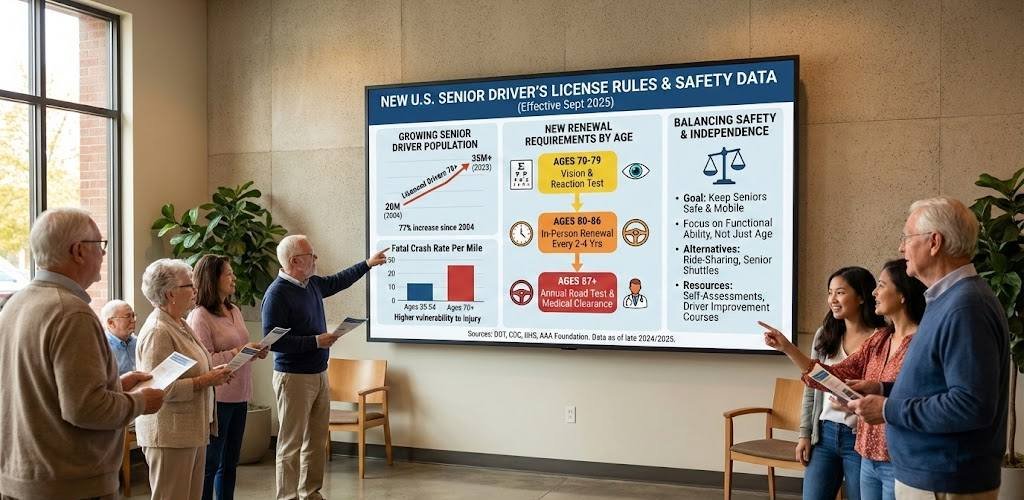
As a practicing lawyer, I spend a lot of time talking with older drivers and their families about new U.S. senior driver’s license rules. These conversations usually don’t start with laws or regulations. They start with real problems: a notice from the DMV that doesn’t make sense, a failed vision test, a car accident that suddenly puts a license at risk, or a worried adult child asking, “Can the state really take my mom’s license away?”
This is written for people dealing with those real situations. I’ll explain how new U.S. senior driver’s license rules actually work, how they vary by state, what triggers license reviews, and what I’ve seen go wrong in real cases. I’ll also share practical advice I give clients every week.
Understanding New U.S. Senior Driver’s License Rules
What People Mean by “New Rules”
When clients ask me about new U.S. senior driver’s license rules, they often assume there is a single national law that applies everywhere. That’s not how driver licensing works.
There is no single federal rule for senior drivers. Instead:
- Each state sets its own licensing and renewal rules
- States update policies regularly, often quietly
- Changes are usually tied to renewal cycles, testing requirements, or medical reviews
So when you hear about new U.S. senior driver’s license rules, what’s really happening is a patchwork of state-level changes that affect older drivers differently depending on where they live.
Why States Are Changing Senior License Rules
In my experience, state lawmakers aren’t trying to punish older drivers. The push behind new U.S. senior driver’s license rules usually comes from three places:
- Accident data involving older drivers
- Longer life expectancy and more seniors driving
- Concerns about medical conditions affecting driving ability
States are trying to balance safety with independence. That balance doesn’t always land fairly, and that’s where legal problems start.
How New U.S. Senior Driver’s License Rules Vary by State
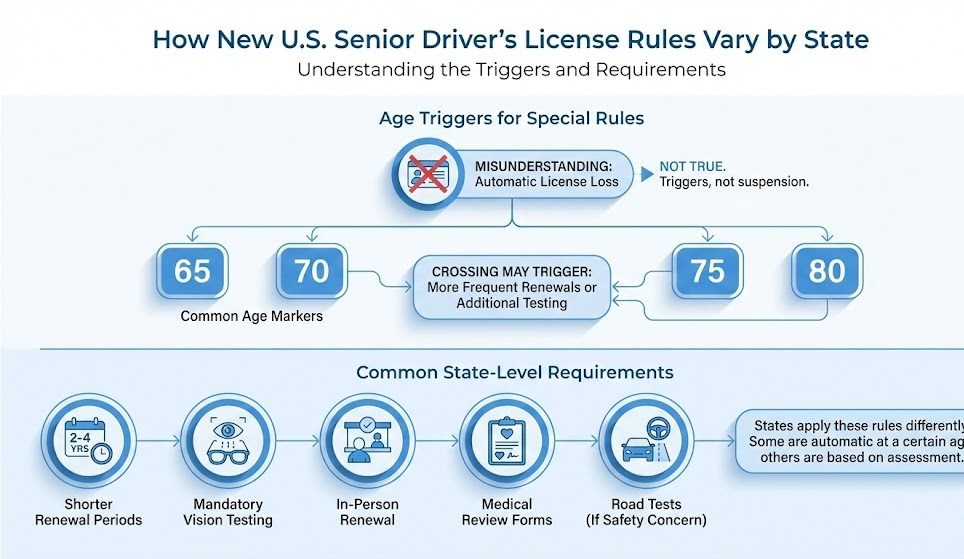
Age Triggers for Special Rules
One of the biggest misunderstandings I see is the belief that turning a certain age automatically means losing your license. That’s not true.
Under new U.S.U.S. senior driver’s license rules, states often set age thresholds that trigger extra steps rather than automatic suspension.
Common age markers include:
- 65
- 70
- 75
- 80
Crossing one of these ages may require more frequent renewals or additional testing.
Common State-Level Requirements
Here’s what new U.S. senior driver’s license rules often include at the state level:
- Shorter renewal periods (every 2–4 years instead of 6–8)
- Mandatory vision testing at each renewal
- In-person renewal instead of online or mail
- Medical review forms signed by a doctor
- Road tests if there’s a safety concern
Some states apply these rules automatically at a certain age. Others only use them if there’s a triggering event.
Vision Testing Under New U.S. Senior Driver’s License Rules
Why Vision Is a Major Focus
Almost every version of the new U.S. senior driver’s license rules emphasizes vision. That’s because vision issues are easy for the state to test and document.
But vision testing causes more license problems than almost anything else.
Example from My Practice
I represented a 78-year-old client who had driven safely for decades. At renewal, she failed the DMV vision screen by one line. She panicked, assumed her license was gone, and stopped moving immediately.
In reality, under her state’s new U.S. senior driver’s license rules, she was entitled to:
- A retest with corrective lenses
- A medical vision report from her eye doctor
- A temporary license during review
She didn’t know this until she spoke with a lawyer.
Common Vision-Related Mistakes
I regularly see seniors make these mistakes under the new U.S. senior driver’s license rules:
- Not wearing updated glasses to the DMV
- Assuming a failed screen means permanent loss
- Letting a temporary suspension lapse into a full one
- Ignoring appeal deadlines
Most of these problems are avoidable with the correct information.
Medical Reviews and Doctor Reports
When Medical Reviews Are Triggered
Medical reviews are a significant part of new U.S. senior driver’s license rules, but they don’t happen randomly.
They are usually triggered by:
- A car accident
- A police officer’s report
- A doctor reporting a condition (in some states)
- A family member’s request
- A DMV employee’s concern
Once triggered, the process can feel intimidating.
Conditions That Raise Red Flags
Under new U.S. senior driver’s license rules, DMV reviewers often look closely at:
- Dementia or cognitive impairment
- Stroke history
- Parkinson’s disease
- Seizure disorders
- Vision loss
- Medication side effects
Important point: having a condition does not automatically mean license loss. What matters is functional ability.
Lawyer’s Advice on Medical Forms
I tell clients this all the time: never rush medical forms.
Doctors often check boxes quickly. A single poorly worded answer can trigger suspension under new U.S. senior driver’s license rules, even if the driver is actually safe.
Whenever possible:
- Review the form before submission
- Ask the doctor to be specific, not vague
- Include supporting notes if allowed
Road Tests and Senior Drivers
When Road Tests Are Required
Road tests are less standard but still part of new U.S. senior driver’s license rules in many states.
They usually happen when:
- There’s a recent accident
- A medical condition affects reaction time
- A vision issue raises concerns
- A license was previously suspended
What Seniors Struggle With Most
From what I’ve seen, older drivers fail road tests not because they’re unsafe, but because they:
- Are unfamiliar with modern test expectations
- Get nervous under observation
- Don’t practice in advance
- Drive too cautiously in ways examiners dislike
Practical Preparation Tips
Before a road test under the new U.S. senior driver’s license rules, I suggest:
- Practicing with a calm third party
- Reviewing state-specific test routes, if available
- Driving during the same time of day as the test
- Addressing small habits like rolling stops
License Renewal Changes for Seniors
Shorter Renewal Cycles
One of the most common new U.S. senior driver’s license rules involves shorter renewal periods.
Instead of renewing every 6–8 years, seniors may need to renew every:
- 2 years
- 3 years
- 4 years
Missing a renewal deadline can cause unintended suspension.
In-Person Renewal Requirements
Many states now require in-person renewal for older drivers under new U.S. senior driver’s license rules.
This allows the DMV to:
- Check vision
- Observe mobility
- Ask questions if concerns arise
Skipping an in-person appointment can cause delays or license lapses.
Family Members and Reporting Concerns
Can Family Members Report a Senior Driver?
Yes. Under many new U.S. senior driver’s license rules, family members can submit a concern to the DMV.
This is one of the most emotionally charged issues I deal with.
What Happens After a Report
A family report does not automatically revoke a license. It usually leads to:
- DMV review
- Possible medical forms
- Possible testing
- A decision based on evidence
Unfortunately, family reports sometimes escalate unnecessarily.
Common Family Mistakes
I’ve seen families:
- Report without discussing concerns first
- Overstate issues out of fear
- Misses deadlines for follow-up paperwork
Once a report is filed, it’s hard to undo.
Appeals and Hearings Under New U.S. Senior Driver’s License Rules
The Right to Appeal
Many seniors don’t realize they have appeal rights under the new U.S. senior driver’s license rules.
Depending on the state, drivers may have:
- Administrative hearings
- Written appeals
- Medical review boards
Deadlines are strict.
Real Case Insight
I handled a case in which a client lost appeal rights because the DMV notice was misinterpreted. The letter looked like routine mail. It wasn’t.
Under new U.S. senior driver’s license rules, failing to act within 10–30 days can result in a suspension.
Common Myths About Senior Driver License Laws
| Myth | Reality Under New U.S. Senior Driver’s License Rules |
|---|---|
| Myth 1: Turning 80 Means Automatic Revocation | False. Age alone does not cancel a license. Under the new U.S. senior driver’s license rules, additional steps may apply, but there is no automatic loss of driving privileges based solely on age. |
| Myth 2: Doctors Always Decide | Incorrect. Doctors provide medical information, but the DMV—not the doctor—makes the final licensing decision under the new U.S. senior driver’s license rules. |
| Myth 3: Once Suspended, It’s Over | Not true. Many suspensions can be appealed, reviewed, or reversed depending on the reason and the evidence provided under the new U.S. senior driver’s license rules. |
Practical Advice I Give Senior Driver Clients
Here’s what I consistently recommend to clients navigating new U.S. senior driver’s license rules:
- Keep medical records organized
- Renew early, not late
- Take DMV notices seriously
- Don’t assume the worst
- Ask for clarification before giving up driving
Small steps can prevent big problems.
When Legal Help Makes Sense
Not every situation requires a lawyer. But under new U.S. senior driver’s license rules, legal help is often helpful when:
- A license is suspended or revoked
- A medical condition is misunderstood
- An appeal deadline is approaching
- A family dispute is involved
I’ve seen many cases resolved simply because someone knew how the process actually works.
Final Thoughts on New U.S. Senior Driver’s License Rules
New U.S. senior driver’s license rules are not about pushing seniors off the road. They are about assessing safety, sometimes clumsily, sometimes unfairly.
The biggest problem I see is not the rules themselves, but confusion about them. Seniors give up driving rights they could have kept. Families panic instead of planning. Deadlines are missed.
If you or someone you care about is dealing with new U.S. senior driver’s license rules, slow down, read every notice, and understand your options. In many cases, the situation is far more manageable than it first appears.
Driving is independence. The law recognizes that, even when it doesn’t always show it clearly.